From Surveys to Signals: Interpretable Machine Learning for Predicting Employee Commitment and Hybrid-Work Effectiveness in Sri Lankan IT Firms
APIIT International Research Conference (AIRC) 2026 · 1 October 2026
Co-authors
My role: Presenter and co-author
Short version: HR driver rankings built from correlated survey data can shift between resamples, but picking just two survey constructs kept 96–100% of full-model accuracy and was stable in every run. I presented this at AIRC 2026 and won the Best Presenter Award.
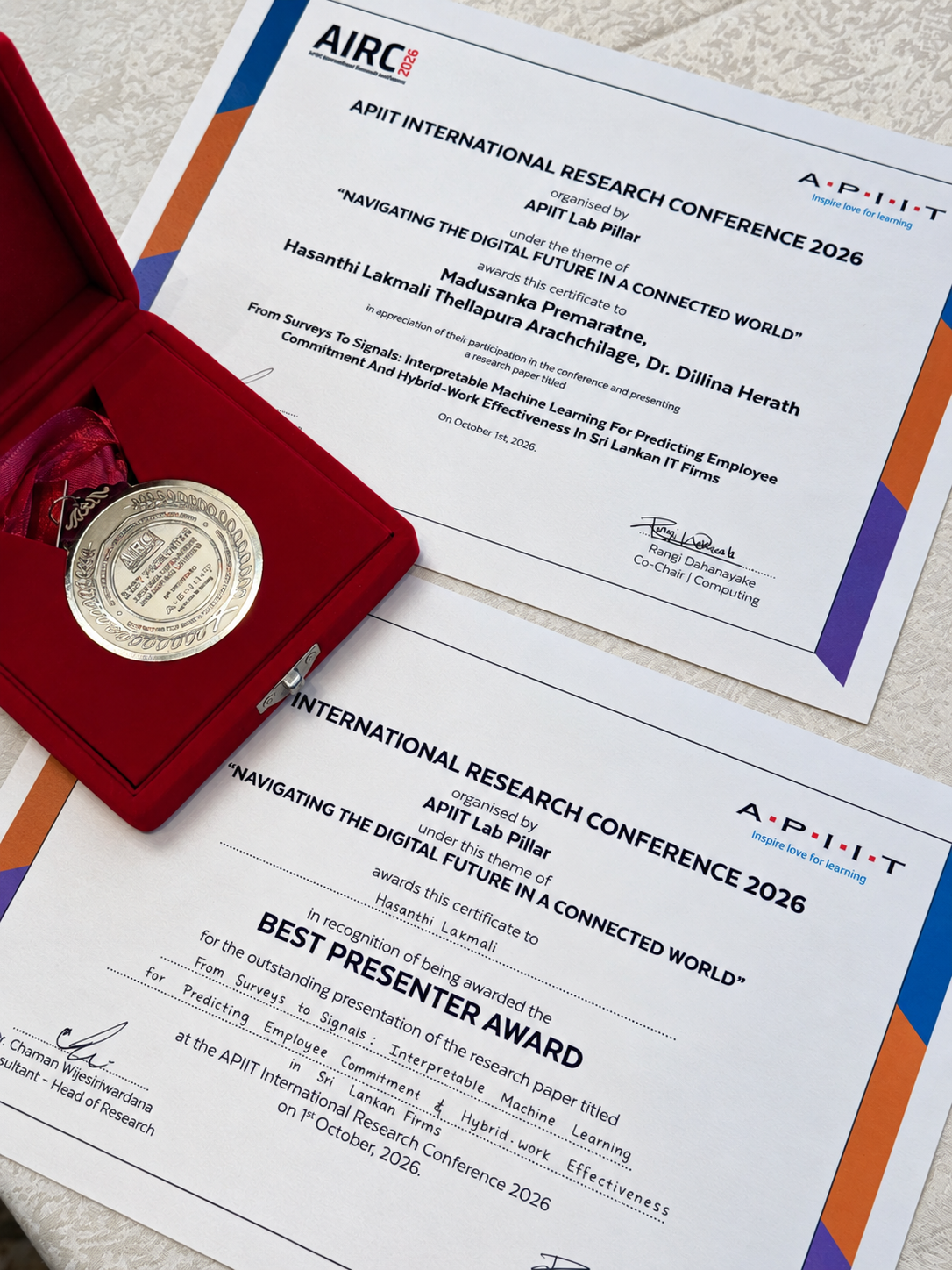
I presented this paper in person at the APIIT International Research Conference (AIRC) 2026 in Colombo on 1 October 2026, and the presentation won me the Best Presenter Award. I am a co-author, not the lead author. Madusanka Premaratne led the analysis and is the corresponding author; I brought the HR practitioner's reading of the results and delivered the talk.
This page is my version of the story: why the question matters to people who run HR for a living, what I took away from the findings, and what I would change in a real survey programme on Monday morning. For the full technical write-up, see the lead author's page linked above.
The question I care about as an HR practitioner
People analytics tools now hand HR teams a neat ranked list: these are the drivers of employee commitment, these are the drivers of hybrid-work effectiveness. Leaders act on those lists. But survey constructs such as trust, communication or leadership support tend to move together, and when inputs are that correlated, one ranking can look very different from the next.
The paper turns that worry into a testable question: when features are this correlated, are the resulting driver rankings actually stable? If they are not, an HR team that redesigns policy around the top-ranked driver may be reacting to noise.
What we worked with
We combined 761 respondents from two surveys that were collected independently of each other. One was the Gen Z Job Commitment Study dataset. The other was the hybrid-work effectiveness survey (375 employees) from my own MBA research on large IT companies in Sri Lanka, so part of this work grew directly out of my earlier study.
How the stability test worked
We fitted three kinds of model: linear regression, random forest and gradient boosting. Each was evaluated with repeated cross-validation over 75 resampled folds, so we could watch how the answers moved from one resample to the next rather than trusting a single run.
We then asked three different attribution methods, raw correlation, standardised linear coefficients and SHAP, which constructs mattered most, and compared their answers with each other.
What stood out to me
The three methods did not agree on the primary drivers, and the SHAP rankings shifted when the data was resampled. For anyone who treats a SHAP chart as the final word, that is the uncomfortable part.
The encouraging part is that a minimal instrument built from just two survey constructs kept 96 to 100 per cent of the accuracy of the full model, and the same two constructs were picked in 100 per cent of the resampling runs. The ranking inside the list wobbled, but the decision about which two constructs to keep did not.
What I would do with this in an HR team
These are my own practitioner takeaways, not claims from the paper. First, check stability before acting: if a driver ranking changes when you resample, do not build a policy on its order. Second, shorter surveys can be enough. A two-construct pulse survey is quicker to answer and collects less personal data, which suits privacy-minded teams. Third, treat explanations as evidence to be tested, not as answers.
The usual caveat applies. The data comes from two surveys of Sri Lankan IT employees, so the pattern should be re-checked before anyone assumes it holds in another industry or country.
What the panel asked during the presentation
The panel's questions were mostly practical rather than technical. They asked about my industry experience in HR, about what this looks like in practical, hands-on work in the field, and about where future research should go next.
The panel's interest in field experience matches how I see this work. Researchers want to know how far the findings generalise, but HR practitioners want to know whether a driver ranking can be trusted enough to act on. That is the reason this page is written from the practitioner side.
Presenting at AIRC 2026 and the Best Presenter Award
AIRC 2026 was organised by the APIIT Lab Pillar under the theme "Navigating the Digital Future in a Connected World", and our paper was presented in the Data Science and Artificial Intelligence track. The Best Presenter Award recognised the presentation of this paper. The certificate and medal are in the photo above.
It follows my Best Poster Presenter award at EICON 2026 for EdgeTal, our on-device recruitment AI, which I also co-authored.
Key findings
- I presented it at AIRC 2026 on 1 October 2026 and won the Best Presenter Award
- 761 respondents from two independent surveys
- Correlation, linear coefficients and SHAP disagreed on the top drivers
- SHAP rankings shifted under resampling
- A two-construct instrument kept 96–100% of full-model accuracy, chosen in 100% of runs
Frequently asked questions
- What is 'From Surveys to Signals' about?
- It tests whether machine-learning driver rankings of employee commitment and hybrid-work effectiveness stay stable when survey constructs are highly correlated, using 761 respondents from Sri Lankan IT firms and three attribution methods including SHAP.
- What was Hasanthi Lakmali's role in the paper?
- Hasanthi Lakmali is a co-author and was the oral presenter at AIRC 2026. Madusanka Premaratne is the lead and corresponding author.
- Which award did the paper win?
- Hasanthi Lakmali received the Best Presenter Award at the APIIT International Research Conference (AIRC) 2026 for presenting the paper on 1 October 2026 in Colombo.
- What is the main practical finding for HR teams?
- Driver rankings from correlated survey data can shift between resamples, but a two-construct minimal instrument kept 96 to 100 per cent of full-model accuracy and was selected in every resampling run, which supports short pulse surveys.
- What did the AIRC 2026 panel ask Hasanthi Lakmali?
- During the presentation, the panel asked about her industry experience in HR, about practical experience applying this in the field, and about suggestions for future research.
- Is the code available?
- Yes. The analysis code is open source under the MIT licence in the surveys-to-signals repository on GitHub.